I've been thinking about Greg Isenberg's post on X the other day:
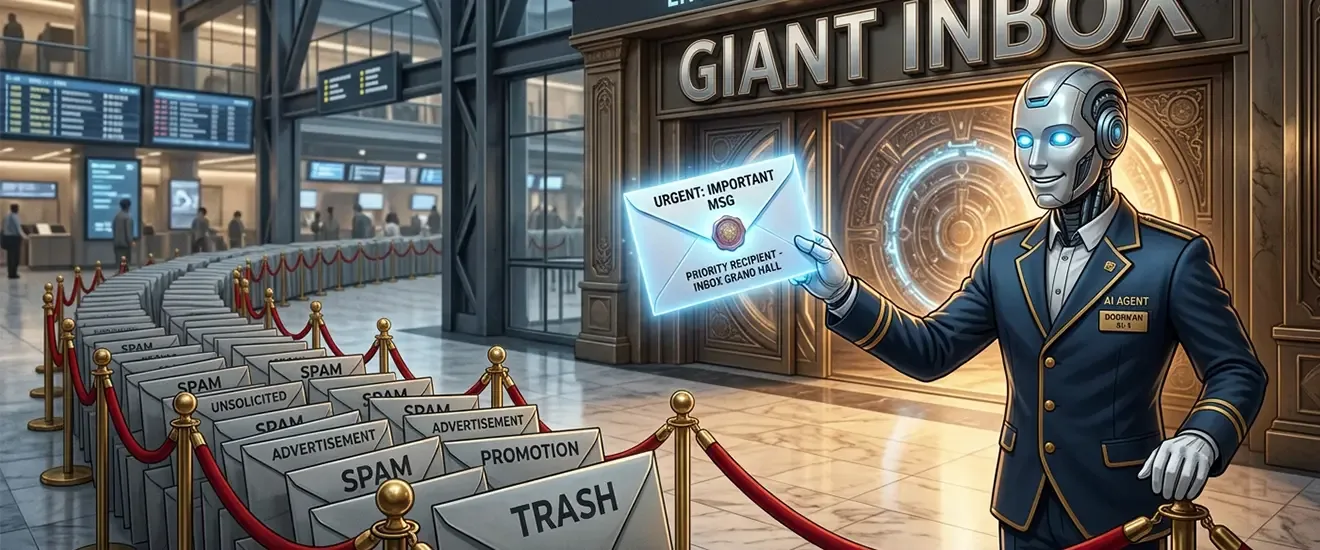
Greg's claim is that inbox agents will become default gatekeepers, so unsolicited email stops working except via warm intros or some rare "interesting enough" exception.
I disagree. I think cold email survives by mutating into a higher-signal channel, and that agents may even improve the economics of good outbound.
Agents are a better filter, not a closed door
Humans already treat most cold email as noise. They skim, delete, or never open it. An agent that can actually read the message, check the sender's company, look at prior contact, estimate relevance to the recipient's current work, and score whether similar people buy this kind of thing is not automatically more hostile than a tired human. It can be more discriminating in the useful direction.
That means the thing that dies is spray-and-pray: 100k barely personalized emails hoping for a 0.3% reply. What remains is outreach that can present evidence: this person, this problem, this timing, this proof. In that world, a tight, specific email can look better to an agent than it currently looks to a human drowning in similar-looking slop. The bar rises; the relative payoff for clearing the bar can rise with it.
This is the same arms race we have already run
Spam filters, Promotions tabs, domain reputation, and resume screens all looked like they would kill the previous channel. They killed the cheap version. Then people optimized for the new judge. An agent gatekeeper is still a filter with criteria. Those criteria become public-ish through trial and error within weeks. Senders will write for the agent the way they now write for Gmail's classifiers and for human pattern-matching.
The historical pattern is not "filter appears → channel dies." It is "filter appears → volume of garbage falls or gets rerouted → remaining traffic has to carry more signal → the channel professionalizes." Cold email has already been through several of those cycles and is still a core B2B motion.
Warm intros do not replace outbound
Warm intros are great and they do not scale to the number of conversations most companies need. Most buyers and most sellers do not share a dense graph. New products, new categories, and companies without famous founders still have to create first contact somehow. If email is no longer that surface, something else has to be, and that something else will have its own gatekeepers (LinkedIn agents, calendar agents, community agents). The underlying job of initiating a relevant conversation with a stranger who has a problem you can solve does not disappear.
Email remains the closest thing to a universal, durable, searchable, permission-light protocol. Agents sit on top of that protocol. They do not retire the address.
"Interesting enough" is not a mystical exception
Greg already concedes a path through: the agent decides you are worth the person's time. That is not a tiny loophole. That is the product spec for the next generation of outbound. Relevance, proof, timing, and reputation become the payload. Tools will exist to assemble that payload from public signals (posts, hiring, tech stack, recent comments, funding, job changes) and to present it in a form an agent can evaluate cheaply.
So the other side's prediction is not that 2023-style sequences keep working. It is:
- Generic cold email dies or gets crushed.
- Signal-based, evidence-heavy, agent-aware outreach continues.
- Reply rates on junk collapse further; reply rates on the remaining targeted mail can stabilize or improve because the inbox is less polluted.
- The skill shifts from "write a clever subject line" to "give the gatekeeper a reason this is not a waste of tokens or attention."
Cold email as a tactic changes. Cold email as the act of reaching a stranger with something specific does not have an obvious replacement that scales better.
Need a targeted B2B contact list?
Tell us who you're after and our researchers hand-build it within 24 hours. 25 free leads a month, forever.
Or browse our industry email lists