Find Local Businesses That Need Marketing Help
How to find local businesses that need marketing help: spot unclaimed Google profiles, few reviews, slow sites and no ads, then reach the owner directly.

Every local business needs marketing. That's the problem with "local businesses" as a target list: it's true of all of them, so it tells you nothing about who to call first.
The businesses worth your Monday morning are the ones with a gap you can see from the outside. A Google listing nobody has claimed. Twelve reviews and a 3.6 rating. A homepage that takes eight seconds to load on a phone. Those are problems the owner can check in thirty seconds after reading your email, and that's what makes them such good openers.
This guide shows you how to find those businesses on purpose, by niche and by city, check each signal for free, filter for them at scale, and reach the owner with an offer that fits the gap. If you want the bigger picture (niche, offer, referrals, follow-ups), start with our guide on how to get clients for your digital marketing agency. This one zooms in on the list.
Why "needs marketing help" beats "small business" as a target
A list of 2,000 dentists is a phone book. A list of 140 dentists in Tampa with fewer than 20 Google reviews is a campaign. Same niche, same city, but every business on the second list has a problem you can name in your first line.
The signals also matter to the owner's customers, which is why owners care when you point them out. BrightLocal's Local Consumer Review Survey 2026 (1,002 US adults) found that:
- 97% of consumers read reviews for local businesses.
- 47% won't use a business with fewer than 20 reviews.
- 68% will only use a business with four or more stars, up from 55% in 2025.
So "you have 11 reviews and your two nearest competitors have 140" isn't a scare tactic. It's a fact the owner can check, tied to a result they want.
Five signals that a local business needs marketing help
Each signal maps to a different kind of agency and a different offer. Pick the one that matches what you sell.
| Signal | What it usually means | Best fit for | Offer it opens |
|---|---|---|---|
| No Google Business Profile, or an unclaimed one | Nobody is managing how the business shows up on Search and Maps | Local SEO agencies | Claim, verify and optimize the profile |
| Few Google reviews or a low rating | Happy customers aren't being asked, or bad reviews go unanswered | Reputation and local SEO agencies | Review generation and response management |
| Slow website | Visitors leave before the page loads, especially on phones | Web design and SEO agencies | Rebuild or speed fix |
| No ad pixels on the site | They aren't running Meta or Google ads, or can't track them | PPC and paid social agencies | A first campaign with tracking set up |
| Independent, not a franchise | The owner decides on marketing, not head office | Everyone | Decides how big your list really is |
The last row isn't a gap, it's a qualifier. A franchise location with an unclaimed profile is still a franchise, and marketing is often handled at head office. Leave them out unless you sell to franchisees on purpose.
How to check each signal by hand (free)
Before you build a list, it's worth checking a handful of businesses manually. You'll learn what "bad" looks like in your niche, and you'll use the same checks later to spot-check your list before you send.
- Unclaimed Google profile. Search the business on Google Maps. If the profile shows a "Claim this business" link, it hasn't been verified. Per Google's help pages, an owner can claim it for free, which makes for an easy, low-risk first project.
- Reviews and rating. The count and star rating sit right under the business name. Compare them with the top three businesses in the map results for the same search. The gap is your pitch.
- Page speed. Run the homepage through Google's free PageSpeed Insights and look at the mobile result. Google's own guidance says a good Largest Contentful Paint is 2.5 seconds or less, so anything well above that is a real, checkable problem.
- Ads. Search the business name in the Meta Ad Library and the Google Ads Transparency Center. No active ads plus a strong review count often means demand they aren't paying to capture.
This works for 10 businesses. It doesn't work for 500, which is where filters come in.
How to find local businesses that need marketing in 6 steps
1Step 1: Pick one niche and one area
Signals only make sense inside a niche. Twenty reviews is a lot for a commercial HVAC company and very few for a restaurant. So pick one business type and one territory first: "med spas within 20 miles of Phoenix", "roofers in Dallas-Fort Worth", "independent restaurants in Chicago".
If you're still choosing, our guide to picking a niche for your agency covers it, and our agency niche report shows which industries agencies actually target, based on 18,370 agency briefs.
2Step 2: Filter for the gap you fix
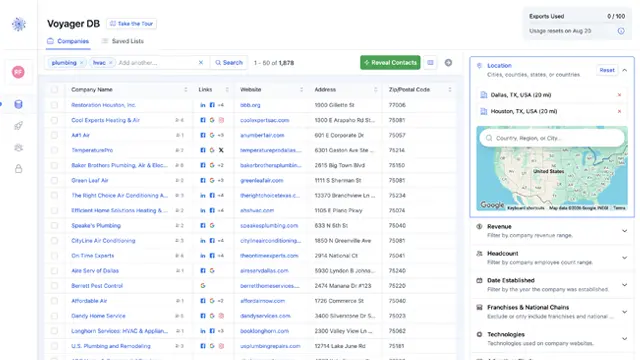
In Voyager DB, every signal above is a filter, and they combine:
- Google Business Profile: has a profile or not, claimed or unclaimed, review count range and rating range (in half stars).
- Website page speed: a from/to range in milliseconds, measured from Virginia. A from value of around 5,000 ms is a sensible starting point for web design prospecting.
- Advertiser pixels: include or exclude Facebook (Meta), Google, LinkedIn and TikTok pixels detected on the website.
- Technologies: 213 detected website technologies, so you can also find sites on DIY builders like Wix, Squarespace or GoDaddy.
You don't have to click through every filter. Search like you'd say it: type "med spas within 20 miles of Phoenix with fewer than 20 Google reviews" and the search assistant suggests the matching filters for you.
To give you a sense of scale: in October 2026, a search for independent med spas within 20 miles of Phoenix with 20 or fewer Google reviews returned 168 businesses. That's a focused campaign, not a phone book.
3Step 3: Make sure they can afford you
A gap doesn't mean a budget. A solo operator with an unclaimed profile may never pay a $1,500 monthly retainer. Add filters for the ability to pay:
- Headcount and revenue ranges. Businesses with roughly 5 to 50 employees usually have the budget but nobody in-house doing marketing.
- Exclude franchises and national chains, so you only reach owners who make their own decisions.
- Date established. A business opened this year needs everything from scratch. One that's been around for 20 years often has a dated site and a review profile nobody has touched in years.
4Step 4: Reach the owner, not the front desk
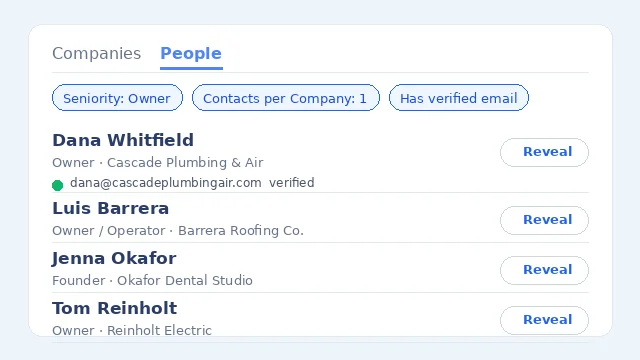
At a 12-person med spa, the owner signs off on marketing. The receptionist doesn't. Switch to the People tab, set seniority to Owners & Founders and set Contacts per Company to 1, so you get exactly one decision-maker per business. 9 in 10 people in Voyager DB are owners or decision-makers.
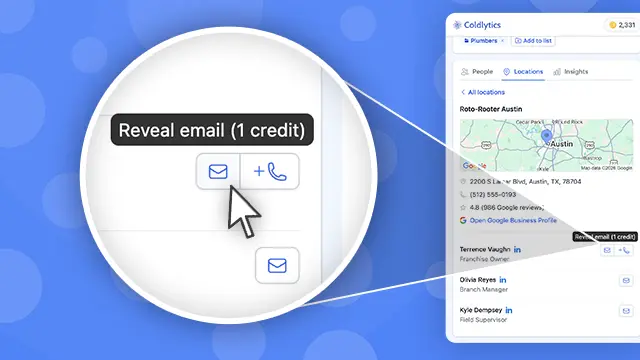
Then reveal their emails. A verified email costs 1 credit, a direct dial is 1 credit, and catch-alls are free on instant reveals. Every email is verified with ZeroBounce at reveal time, and invalid ones are never charged.
5Step 5: Spot-check before you send
Signals change. An owner claims their profile, a burst of new reviews lands, a site gets rebuilt. Before you launch, open 10 businesses from your list and run the free checks from earlier. If your opener says "your profile isn't claimed" and it is, you've lost that owner for good.
Also check that the signal belongs to the right location. Google review filters apply to the listing in the area you searched, so a multi-location business can look different branch to branch.
6Step 6: When the database runs out, hand it to researchers
Tight briefs run dry, especially in smaller cities. Don't loosen your filters until the list stops making sense. Hand the rest of the search to our Contact Research team in one click, with your filters carried over.
The research team can also target things a database can't, like a business's position in the Google Maps results for a search term, or keywords on their website ("botox", "emergency", "commercial"). Up to 1,000 leads land within 24 hours on business days, verified, and exclusive to you for 30 days.
Example searches by agency type
Here's how the signals translate into real lists. Swap in your own niche and city.
| Agency type | Example search | First line it gives you |
|---|---|---|
| Local SEO | Dentists in Tampa with an unclaimed Google profile | "Your Google profile hasn't been claimed yet, so you can't reply to reviews or update your own hours and photos." |
| Reputation management | Independent restaurants in Chicago rated under 4.0 | "Your food photos are great, but your rating sits under 4 stars, and about two-thirds of customers only pick places rated 4 or more." |
| Review generation | Med spas within 20 miles of Phoenix with fewer than 20 reviews | "You have 14 reviews. The three spas above you in the map results each have over 100." |
| Web design | Roofing companies in Dallas with page speed over 5,000 ms | "Your homepage took more than five seconds to load on my phone." |
| PPC | HVAC companies in Columbus with 100+ reviews and no Google or Meta pixel | "You clearly do great work. You're just not paying to show up when people search for it." |
| Brewery and winery marketing | Craft breweries in Denver with no Facebook pixel | "Your taproom events look packed, but there's no way to retarget the people who check them out online." |
For ready-made starting points, see our pages on med spa and beauty salon email lists, restaurant owner email lists and food and beverage email lists, which covers breweries, wineries and other producers.
Turn the signal into the first line
The signal is your opener. The rest of the email is short:
- What you noticed. One specific, checkable fact.
- Why it matters. One line, tied to customers, not to your service.
- A small, free fix. Something you can send without a call.
For example, for a web design agency:
Hi Dana,
I looked up roofers near Plano and your site took about seven seconds to load on my phone. Most people searching for a roofer on mobile won't wait that long.
I put together the three changes I'd make first. Want me to send them over?
Keep the tone helpful, not alarming. "Your profile isn't claimed" is useful. "You're losing thousands of dollars a month" is a guess, and owners know it.
Mistakes that waste a good signal
- Pitching every gap at once. A list of seven problems reads like an audit nobody asked for. Lead with one.
- Ignoring service-area businesses. Plenty of plumbers and roofers hide their address on Google. That's normal, not a problem to pitch.
- Treating a new business like a neglected one. A two-month-old bakery with six reviews isn't failing. It's new. Change the pitch to "get the first 50 reviews".
- Emailing info@ addresses. Generic inboxes rarely reach the owner. Find the decision-maker.
- Skipping the spot-check. One wrong claim in your opener and the owner stops reading.
FAQ
How do I find businesses without a Google Business Profile?
By hand, it's slow: a business with no profile doesn't appear on Google Maps at all, so you have to spot it in directories or regular search results and check Maps one by one. At scale, use the Google Business Profile filter in Voyager DB to show only businesses with no profile, or with an unclaimed one, in your area.
How do I find local businesses that need a website or a better one?
Look for slow load times, dated website builders and missing basics like mobile layouts. PageSpeed Insights checks one site at a time. In Voyager DB, filter by page speed and by technologies such as Wix, GoDaddy or Squarespace across a whole city or state.
How many Google reviews counts as "few"?
It depends on the niche, so compare against the top three businesses in the local map results. As a benchmark, BrightLocal's 2026 survey found 47% of consumers won't use a business with fewer than 20 reviews, which makes 20 a sensible first cut for most local niches.
Should I target businesses with bad reviews?
Yes, if you sell reputation management, and carefully. Lead with how they can respond and recover, not with the reviews themselves. A business rated under 4 stars is invisible to many customers, so the fix has real value to the owner.
Need a targeted B2B contact list?
Tell us who you're after and our researchers hand-build it within 24 hours. 25 free leads a month, forever.
By signing up, I agree to Coldlytics' Terms of Service and Privacy Policy.