How to Get Clients for Digital Marketing in 2026
A practical 2026 playbook for winning agency clients: pick a niche, package an offer, use referrals, then build Main Street lists with deep data.
 Matthew McQuinn· · Updated

Every agency owner I know has had the same month. A big client leaves, the pipeline is empty, and suddenly you're refreshing your inbox hoping someone fills in the contact form.
I spent years as a director at two multiple-seven-figure agencies, and I've sent more cold email than I'd like to admit. The agencies that never have that month aren't luckier. They pick a narrow market, make an offer that's easy to say yes to, and run two or three channels every single week, whether they're busy or not.
This guide is the playbook I'd use if I were starting an agency today, or rebuilding a quiet pipeline. It's written for agencies that sell to small and local businesses, which is most of you: dentists, roofers, med spas, law firms, restaurants and the rest of Main Street.
Where agency clients actually come from
Before you pick channels, it's worth looking at what works for other agencies.
In August 2026, Promethean Research asked 91 agency leaders to rate 34 new-business tactics by how much revenue each one brings in, on a scale of 1 to 5. The top of the list looks like this:
| Tactic | Rating (1 to 5) | Share of leaders putting effort in |
|---|---|---|
| Client referrals | 3.7 | 67% |
| Growing current accounts | 3.6 | 68% |
| Partner referrals | 3.0 | 53% |
| Upselling services | 2.9 | 59% |
| Case studies | 2.1 | 34% |
| SEO/SEM | 2.0 | 33% |
| Social media content | 2.0 | 41% |
Source: Promethean Research, "How Marketing Agencies Get Clients in 2026".
The part most people skip is further down the same report. When the researchers split agencies by how complex their sale is, the ones selling to small companies told a different story. For them, pay-per-click scored 3.8, and client referrals and outbound email both scored 3.5.
That matches what I've seen. If your clients are owner-run businesses, the owner makes the decision on one call. You don't need a six-month enterprise sales cycle. You need to get in front of enough of the right owners, with the right offer, often enough.
So the plan below has two halves: the relationship channels that convert best, and the outbound engine that keeps the pipeline full when referrals go quiet.
How to get clients for your digital marketing agency in 7 steps
1Step 1: Pick a niche and a geography
"We help businesses grow online" is not a market. Nobody searches for it, nobody refers it, and you can't build a list for it.
The same report found that 55% of agencies now specialize by industry. Specialists win because the prospect can see you've done this exact job before, and because everything else (your case studies, your cold email, your ads) gets sharper.
A good niche statement has three parts: who, where and what problem.
| Weak | Strong |
|---|---|
| SEO for small businesses | Local SEO for family dentists in Tampa and St. Petersburg |
| Facebook ads for anyone | Meta ads that fill the calendar for med spas in Scottsdale |
| Websites for local companies | Fast, mobile-first websites for roofing contractors in Dallas-Fort Worth |
| Marketing for home services | Google Ads and call tracking for HVAC companies in Columbus, Ohio |
Two checks before you commit:
- Can they afford you? A solo operator rarely has a $1,500 monthly retainer in them. Businesses with roughly 5 to 50 employees usually have the budget but no one in-house doing your job.
- Are there enough of them? You want at least a few hundred businesses in your target area, so you can run outreach for months without burning the market.
If you're not sure which niches are worth it, our agency niche report is built from 18,370 agency briefs and shows which industries agencies are actually targeting.
2Step 2: Build an offer that's easy to say yes to
Small business owners don't buy "digital strategy". They buy a result they can picture, at a price they can see.
Turn your service into a package with a fixed scope and a clear monthly price. For example:
- The Booked Calendar package for med spas: Meta and Google ads, landing page and lead follow-up, $2,000 a month plus ad spend.
- The Map Pack sprint for dentists: Google Business Profile cleanup, review generation and local landing pages, $1,200 a month for six months.
Then give prospects a small, specific piece of free value to start the conversation. Keep it quick to produce, so you can do it at volume:
- A two-minute screen recording walking through their Google Business Profile and what's missing.
- A page-speed check of their homepage with the three fixes you'd make first.
- A side-by-side of their ads against two local competitors.
The free piece isn't the pitch. It's proof you looked at their business, which is more than most agencies emailing them have done.
3Step 3: Ask every happy client for one introduction
Client referrals scored highest in the research, and they're the channel most agencies run by accident.
Make it a process instead:
- Ask at the high point. Right after a launch, a record month or a "this is amazing" email, ask: "Who else do you know who runs a practice like yours?"
- Be specific. "Do you know any other orthodontists in Hillsborough County?" gets names. "Know anyone who needs marketing?" gets a polite nod.
- Put it on the calendar. Pick your three happiest clients every quarter and ask each one for an introduction.
- Close the loop. Tell the referrer what happened, whether or not it closed. People who hear back send the next one.
A referral fee or a free month for every signed client helps, but in my experience the specific ask matters more than the incentive.
4Step 4: Partner with businesses that already serve your niche
Partner referrals were the third-highest rated tactic, and they're the most underused.
Think about who already has a trusted relationship with your ideal client but doesn't do what you do:
- Dentists: dental supply reps, practice management consultants, dental accountants and equipment financing companies.
- Home services: suppliers and distributors, field-service software resellers, local trade associations.
- Med spas: injector trainers, laser equipment vendors, aesthetics suppliers.
- Any local business: web developers who don't do marketing, bookkeepers, commercial insurance agents.
Offer a referral fee or a reciprocal arrangement, and agree up front on who introduces whom and how often. One good partner can be worth more than a year of social posts.
5Step 5: Build a prospect list with deep data
Referrals and partners convert best, but you can't control when they arrive. Outbound is the channel you can turn up on a Monday morning. And outbound lives or dies on the list.
A good list for an agency has three qualities:
- It's the right businesses. Your niche, your area, a size that can afford you, and ideally a visible reason they need you.
- It reaches the owner. At a 12-person HVAC company, the owner signs off on marketing. The office manager forwards your email to the trash.
- The emails are verified. Bounces hurt your sending domain and every campaign after it.
This is where generic databases struggle. The big enterprise tools are built for selling to tech companies and corporations. They're thin on the independent dentist, the family-run roofer and the med spa with two locations.
The data you want on each local business goes well past name and address. Here's what to search on, and why it matters for an agency:
| Data point | Why an agency cares |
|---|---|
| Business category and location (city radius, county, ZIP) | Your niche and territory, in one search |
| Headcount and revenue range | Filters out businesses too small to afford a retainer |
| Independent vs franchise or national chain | Franchise marketing is often decided at head office, so independents are usually better targets |
| Residential vs commercial customers (trades) | Pitch a commercial roofer differently from a residential one |
| Website technologies (WordPress, Wix, Shopify, HighLevel and more) | Tells a web designer who's on a DIY builder, and tells you what you'd be working with |
| Ad pixels (Meta, Google, LinkedIn, TikTok) | Shows who already spends on ads, and who has never tried |
| Google reviews, rating and whether the profile is claimed | A strong opener for local SEO and reputation offers |
| Website page speed | A concrete, checkable problem for SEO and web design agencies |
| Date established | New businesses need everything; 20-year-old businesses often need a refresh |
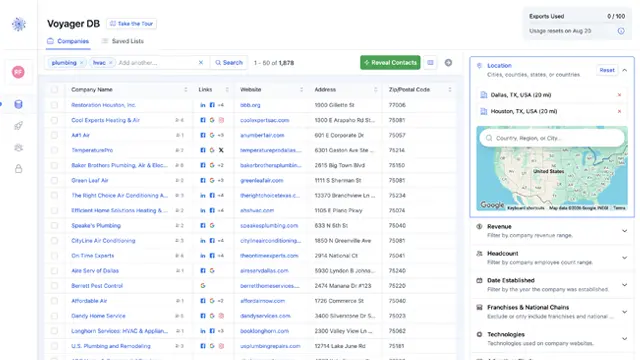
In Coldlytics, every one of these is a filter in Voyager DB, across 10M+ small businesses and 325 categories. You can also just type what you're after, like "med spas within 20 miles of Scottsdale with fewer than 50 Google reviews", and the search builds the filters for you.
Two settings matter more than they look:
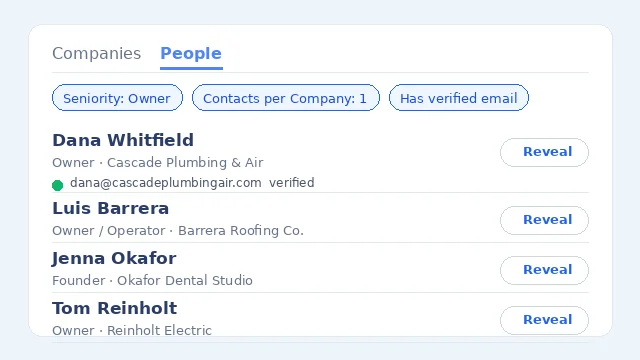
- Contacts per Company = 1. Keep exactly one decision-maker per business, so you don't email three people at the same dental office and look like a spammer. 9 in 10 people in Voyager DB are owners or decision-makers.
- Dedupe and suppression lists. If you prospect for several niches or clients, upload your current clients and anyone who's opted out as a suppression list. They'll be left out of every search and research task.
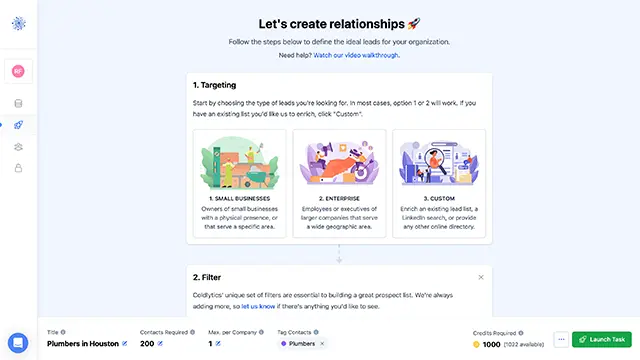
When the database runs dry for a very specific brief, hand it to our Contact Research team. Human researchers build the list to your exact criteria, up to 1,000 leads within 24 hours on business days, and those contacts stay exclusive to you for 30 days.
6Step 6: Run cold email that sounds like a person
With a tight list and a clear offer, cold email gets simple. Most of the work is not ruining it.
- Short and specific. Three to five sentences. Lead with what you noticed about their business, then the result you get for businesses like theirs, then a low-effort ask.
- One free piece of value. "I recorded a two-minute walkthrough of your Google profile. Want me to send it over?" beats "Do you have 15 minutes this week?"
- Three follow-ups. Plenty of replies come from a follow-up, not the first email. Space them a few days apart and change the angle each time. Our follow-up guide covers cadence and angles.
- Protect deliverability. Send from a secondary domain, warm it up, stay around 30 emails a day per inbox and keep bounces under 2%. Verified lists make that last part easy.
- Steer clear of AI slop. Owners can spot a generic AI email in one line. Use AI to research and draft, then make it sound like you.
Here's the shape of a first email that works for a local SEO agency:
Hi Maria,
I was looking for a dentist near Hyde Park and noticed your practice doesn't show up in the map results, even though your reviews are better than the two offices that do.
We help family practices in Tampa get into the top three on Google Maps. I put together a quick list of the three fixes I'd make first on your profile.
Want me to send it over?
If you want more templates, our guide to getting agency clients with cold email has them, and our subject line formulas will help with opens.
7Step 7: Add one inbound channel and give it two quarters
Inbound takes longer, but it compounds. Pick one channel that matches what your team already enjoys doing, and stick with it for six months before you judge it:
- Case studies. One page per niche, with real numbers in the headline, in the style of "How a Scottsdale med spa went from 4 to 31 booked consults a month". Use them in every email and proposal too.
- LinkedIn. Post about the work your niche cares about, two or three times a week. Owners and partners read it, even if they never comment.
- Local SEO for your own agency. "Dental marketing agency Tampa" is a search your future clients actually type.
- Industry communities. Facebook groups, trade association events and local chamber meetings where your niche spends time. Answer questions; don't pitch.
Our post on AI assistants for marketing agencies covers how to take some of the busywork out of content and research, so this doesn't eat your week.
What about paid ads and direct mail?
Both work, especially once you have a clear niche and offer. Both also get expensive quickly with the wrong audience.
The trick is the same as with cold email: start from a tight list. Upload your prospect list to Google or Meta as a custom audience, and you're paying to reach owners you've already qualified, not everyone with a pulse in your ZIP code. Our Google Customer Match guide walks through it.
Direct mail is underrated for local businesses. A postcard or a short letter with a printed audit lands on the owner's desk, not in a spam folder. It costs real money per piece, so only send it to your best-fit prospects, and follow up by email.
A simple 30-day plan
If your pipeline is empty right now, here's how I'd spend the next month:
| Week | Focus | Output |
|---|---|---|
| 1 | Niche, offer and proof | One-sentence niche, one packaged offer with a price, one case study page |
| 2 | Relationships | Referral asks to your three happiest clients, three partner conversations booked |
| 3 | List and outreach | 300 to 500 verified owner contacts in your niche, first cold email sequence live |
| 4 | Follow up and review | Follow-ups running, replies booked into calls, numbers reviewed and the weakest email rewritten |
Then keep going. Most agencies stall because they stop prospecting the moment they get busy, and the empty month comes back three months later.
Mistakes that keep agencies stuck
- Targeting everyone. Broad positioning makes every channel weaker, from referrals to ads.
- Buying cheap, stale lists. Old data means bounces, wrong people and a burned domain.
- Emailing info@ addresses. Generic inboxes rarely reach the owner. Find the decision-maker.
- Pitching in the first line. Lead with something you noticed about their business.
- Prospecting in bursts. Two hours every week beats two weeks every quarter.
- Never asking for referrals. Your happiest clients won't volunteer introductions. Ask.
FAQ
How do I get my first client as a new digital marketing agency?
Start with your own network and one narrow niche. Offer a small fixed-scope project at a fair price to get a case study, then ask that client for an introduction. In parallel, build a short list of owner contacts in your niche and send personal emails with one piece of free value, like a quick audit of their Google profile.
How do I get SEO clients for my agency?
Target local businesses with a visible SEO problem: a weak or unclaimed Google Business Profile, few reviews, or a slow website. Open with that specific issue and the fix, not a general pitch. Case studies with ranking and lead numbers from the same niche close faster than anything else.
How many prospects do I need to contact to win a client?
It depends on your niche, offer and price, so track your own numbers. Measure reply rate, calls booked and close rate for each campaign, then work backward from the number of new clients you want each month. Start with a few hundred well-targeted contacts and adjust from there.
Is it better to use referrals or cold outreach?
Use both. Referrals convert best but arrive when they arrive. Cold outreach is the channel you control, and for agencies that sell to small businesses it rates almost as high as referrals. Running both means one quiet month doesn't empty your pipeline.
Need a targeted B2B contact list?
Tell us who you're after and our researchers hand-build it within 24 hours. 25 free leads a month, forever.
By signing up, I agree to Coldlytics' Terms of Service and Privacy Policy.